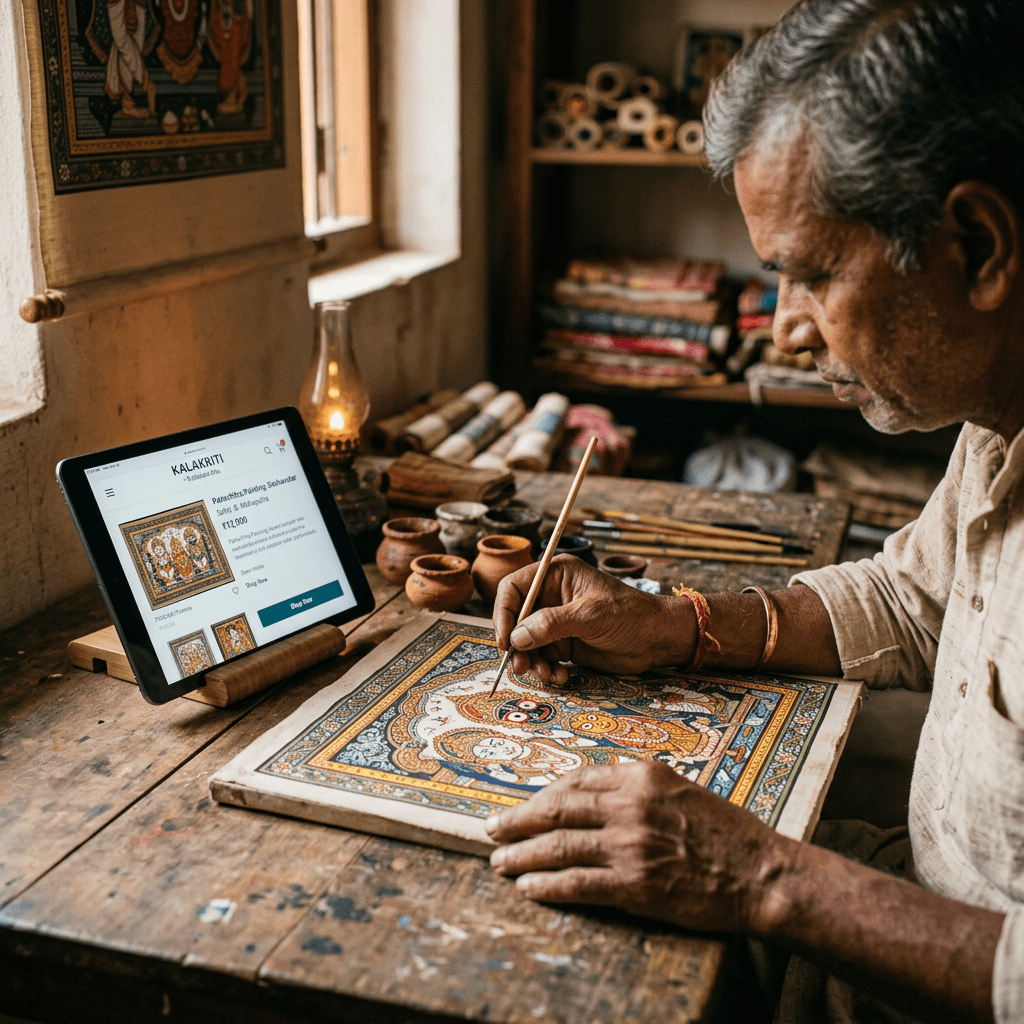
Revitalizing Heritage Skills
This project modernizes Odisha’s traditional crafts to ensure they remain economically viable by providing artisans with design innovation training, digital branding, and direct market linkages. By integrating modern tools with indigenous knowledge systems to increase earning potential, we have secured sustainable income growth for master craftsmen and prevented the cultural erosion of traditional artisan clusters.
Year
2025
Domain
Heritage Conservation
SDG COVERED
1 & 11
Date Updated
Subject Area as per ICSSR List
In a step towards preserving India’s rich handloom tradition, the Department of Analytical and Applied Economics, Utkal University, in collaboration with the Development and Environment Futures Trust (DEFT), has undertaken a research project titled “Intergenerational Transfer of Knowledge and Practices amongst Handloom Clusters in Odisha.” The project is being supported by the Indian Council of Social Science Research (ICSSR), Ministry of Education, Government of India and will be conducted over a period of five years covering all handloom clusters of Odisha.
The project aims to build an understanding of the economic and social challenges faced by on handloom weaving households, particularly in Odisha's traditional clusters. It aims to identify actionable, scalable solutions that can empower weavers through enhanced productivity, integrating their business with e-commerce platforms, and making them understand the constraints and negative aspects of business like climate change, market volatility, and environmental factors. The core focus remains on transfer of inter-generational knowledge to enhance weaving practices to stop migration, and shifting aspirations among youth.
As part of this project, a national conference was organized to provide a platform for dialogue among policymakers, researchers, practitioners, and industry leaders. The conference included critical issues such as modernisation, labour migration, and youth engagement, with and aim of exploring innovations to bring together the gaps between modern and conventional skillsets and practices.
Discussions in the workshop highlighted how blending modern technologies and market innovations with traditional wisdom can enhance and aim to achieve sustainable growth. Topics like economic empowerment, women's role, intellectual property right protection through GI tagging, climate resilience, and cooperative institutional frameworks were discussed keeping in mind the Sustainable Development Goals (SDGs)at local level making the artisans close to this practice. Participants called for policy frameworks and interventions to make the handloom sector economically more attractive to the younger generations.